
In the U.S., tax agencies frequently send payroll tax notices to businesses as part of a notice-driven compliance system.
This article explains what payroll tax notices are, the types you might receive, and how Deel can help you handle them quickly and accurately.
In this Article
Payroll Taxes
Payroll tax refers to taxes that employers are required to withhold from employees' wages and pay on behalf of their employees to federal, state, and local governments. These taxes fund programs such as Social Security, Medicare, unemployment insurance, and more.
Who Pays Payroll Taxes?
Some payroll taxes are paid solely by the employer, some by the employee, and others are shared. These taxes may be calculated using:
-
A flat percentage
-
Tax table formulas based on earnings
-
Flat-dollar amounts
Some payroll taxes are not collected until a certain wage threshold has been reached, while other payroll taxes are collected up to a certain Wage Base Limit, or taxable maximum.
- Wage Threshold: Some taxes are not taxable on compensation until a certain annual amount has been paid, or a supplemental tax may apply after a certain threshold has been met.
- Wage Base Limit: Some taxes are only taxable on compensation until a certain annual amount has been paid. Any income earned over the Wage Base Limit is not taxable on compensation paid for the remainder of the calendar year.
Federal Payroll Taxes
Federal Payroll Taxes are taxes paid on the wages and salaries of employees to fund various programs.
Here are the main components of Federal Payroll Taxes:
[ACCORDION]Federal Insurance Contributions Act (FICA) Taxes
FICA Taxes are used to fund Social Security and Medicare benefits for American citizens. FICA Taxes help to fund benefits for retirees, disabled individuals, and their dependents.
FICA consists of two parts:
-
Social Security Tax:
- Social Security Tax is known as the Old Age, Survivors, and Disability Insurance (OASDI).
- Social Security Tax is levied at a total combined tax rate of 12.4%, based on employee compensation.
- Social Security Tax is typically split evenly between employers and their employees, with each paying at 6.2%.
- Social Security Tax is only collected up to a certain Wage Base Limit, set by the Social Security Administration (SSA) each calendar year.
-
Medicare Tax :
- Medicare Tax is levied at a total combined tax rate of 2.9%, based on employee compensation.
- Medicare Tax is typically split evenly between employers and their employees, with each paying at 1.45%.
- There is not a Wage Base Limit set on Medicare Tax however, there is an additional tax for high-income earners.
- Within the calendar year, any wages earned by an employee over the Additional Medicare threshold, will contribute an additional 0.9%. Currently, the wage threshold is $200,000.00 ($250,000.00 for married couples filing jointly).
[/ACCORDION]
[ACCORDION]Federal Income Tax Withholding (FIT)
Federal Income Tax is withheld from employees, by their employer, and paid to the Internal Revenue Service (IRS) on your behalf as a credit toward your personal annual income tax filing.
FIT withholding is calculated based on your earnings each pay period, the information you provide on your Form W-4, which includes your filing status and allowances, as well as the Federal Tax Withholding tables provided by the IRS. The total amount withheld from employees’ paychecks are reported on Form W-2 each year.
Generally, Federal Income Tax Withholding can be changed at any time by submitting a new Form W-4.
[/ACCORDION]
[ACCORDION] Federal Unemployment Tax Act (FUTA) Tax
The Federal Unemployment Tax Act is a program that provides funding for unemployment benefits to employees who have lost employment, through no fault of their own.
The FUTA Tax collected provides funding to unemployment programs in the United States, financial assistance to terminated employees, and supports State Unemployment Insurance agencies.
FUTA is levied at a tax rate of 6% and is funded solely by employers.
Employers may be eligible for a tax credit of up to 5.4%, if they pay State Unemployment Insurance taxes, which reduces the effective rate to 0.6%.
FUTA is collected up to a certain Wage Base Limit each year.
[/ACCORDION]
State Payroll Taxes
State Payroll Taxes are taxes imposed by state governments on employers and/or employees to fund specific state programs.
Here are the main components of State Payroll Taxes:
[ACCORDION]State Unemployment Insurance (SUI)
State Unemployment Insurance (SUI) is a state tax-funded program that provides temporary financial support to workers who have lost their jobs, through no fault of their own.
SUI is mostly funded by employers however, in some states SUI is also funded by employees.
All states recognize a Wage Base Limit however, every state establishes its own Wage Base Limit.
[/ACCORDION]
[ACCORDION]State Income Tax Withholding (SIT)
State Income Tax Withholding (SIT) is similar to Federal Income Tax Withholding however, it is levied at the state level.
SIT Withholding is based on the employee’s earnings and information completed on the state withholding allowance forms.
The amount withheld typically depends on factors such as the employee’s wages, filing status, and the number of allowances, or dependents, claimed.
The calculation for the amount withheld is based on state-published tax tables and brackets, formulas, or a flat-percentage rate, and varies by state. There are nine US states that do not levy SIT Withholding.
[/ACCORDION]
Local Payroll Taxes
Local Taxes, similar to Federal and State Income Taxes, are a type of taxes levied by local cities, counties, municipalities, school districts, or other local jurisdictions.
Local Payroll Taxes are based on where an employee resides or works.
Local Payroll Taxes are calculated in several different ways including a percentage of the employee’s wages, a percentage of the employee’s Federal or State Income Tax, or as a flat amount. Currently in the United States, there are nearly 5,000 local taxing jurisdictions.
Other Types of Payroll Withholdings and Taxes
[ACCORDION]Short-Term Disability Insurance
Short-Term Disability Insurance is a type of insurance coverage that provides wage replacement in instances where an employee is temporarily unable to work due to a non-work-related illness, injury, or medical condition.
Work-related The Short-Term Disability benefit period is typically 3-6 months, with a maximum benefit period of one year.
Benefits are typically payable after a short waiting period of 7-14 days.
Short-Term Disability Insurance premiums are often shared between the employer and employee.
Some states, such as New York, California, and Rhode Island, require employers to provide Short-Term Disability coverage.
[/ACCORDION]
[ACCORDION] Paid Family and Medical Leave (PFML)
Paid Family and Medical Leave (PFML) is a program that provides employees with paid time off for specific family and medical reasons.
PFML allows employees to take paid time off to care for a new child, care for a family member with a health condition, recover from their own health condition, or address needs related to a family member’s military service.
Most PFML programs offer 6-12 weeks of paid leave each year. Benefit eligibility usually requires that the employee meet a minimum wage requirement and must work for a covered employer.
Most PFML programs are funded through both employer and employee contributions.
Several states have implemented their own mandatory PFML programs, with many other states currently in the process of developing their own PFML programs, however, private plans are also available.
[/ACCORDION]
[ACCORDION] Long-Term Care Insurance
Long-Term Care Insurance is a type of insurance policy designed to assist in covering the costs of long-term care services for individuals who need support with daily activities due to chronic illness, disability, or cognitive impairment.
Currently, Washington state is the only state with a mandatory Long-Term Care Insurance program; however, several states are considering similar programs.
[/ACCORDION]
[ACCORDION] Workers’ Compensation
Workers’ Compensation is a form of insurance that provides benefits to employees who suffer work-related injuries or illnesses.
Workers’ Compensation is designed to provide medical care and coverage for work-related injuries or illnesses, rehabilitation and retraining services when applicable, offer partial wage replacement for lost work time, and pay death benefits to dependents resulting in a worker’s death due to a job-related incident.
Most states require employers to carry Workers’ Compensation insurance for their employees.
Each state has its own Workers’ Compensation laws and requirements. By accepting Workers’ Compensation benefits, employees generally waive their right to sue their employer for negligence. Employers are solely responsible for paying Workers’ Compensation premiums.
-
Monopolistic States: Some states require that employers obtain Workers’ Compensation insurance exclusively through a state-run fund, rather than through private insurance companies.
- Currently, there are 4 Monopolistic states: North Dakota, Ohio, Washington, and Wyoming.
[/ACCORDION]
Payroll Tax Notices
What is a Payroll Tax Notice?
A payroll tax notice (also known as a tax assessment) is a formal communication from the IRS or state/local tax agencies. It can indicate:
-
A change in your deposit frequency
-
A rate reassignment (e.g. for unemployment insurance)
-
A missed or late payment or filing
-
Informational updates
Receiving a notice can be stressful, but not all notices require action. Some are purely informational.
How Deel Helps With Payroll Tax Notices
We have a dedicated team experienced in handling payroll tax notices across jurisdictions.
If you receive a notice:
-
Don’t panic - many are informational.
-
Read it carefully - check for deadlines and effective dates.
-
Submit the notice to Deel right away. We’ll investigate and act accordingly.
How to Submit a Payroll Tax Notice to Deel
-
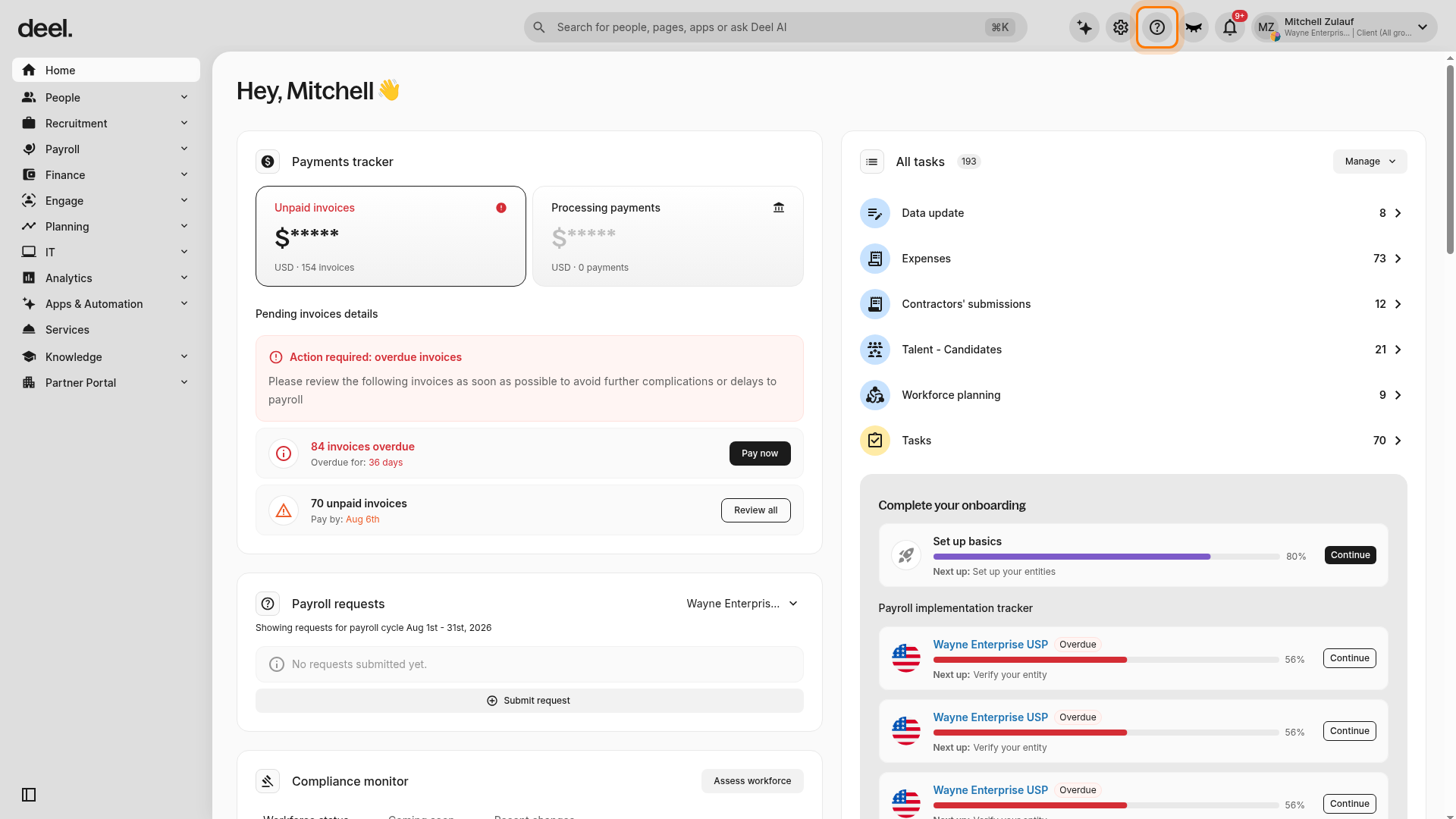
From any page in the Deel dashboard, select the Help question-mark icon in the top-right corner.
-
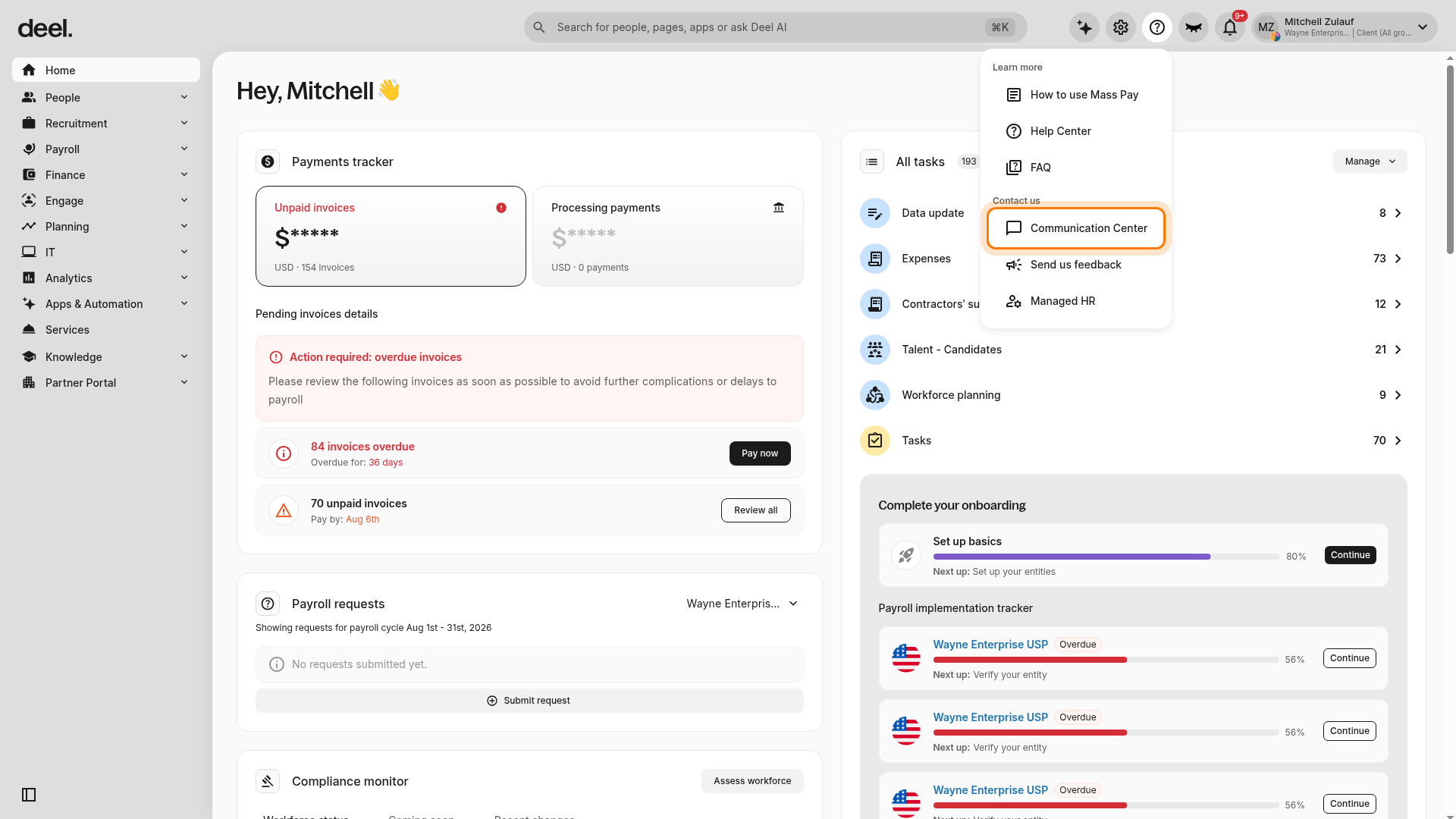
In the Help menu, locate the Contact us section and select Communication Center.
-
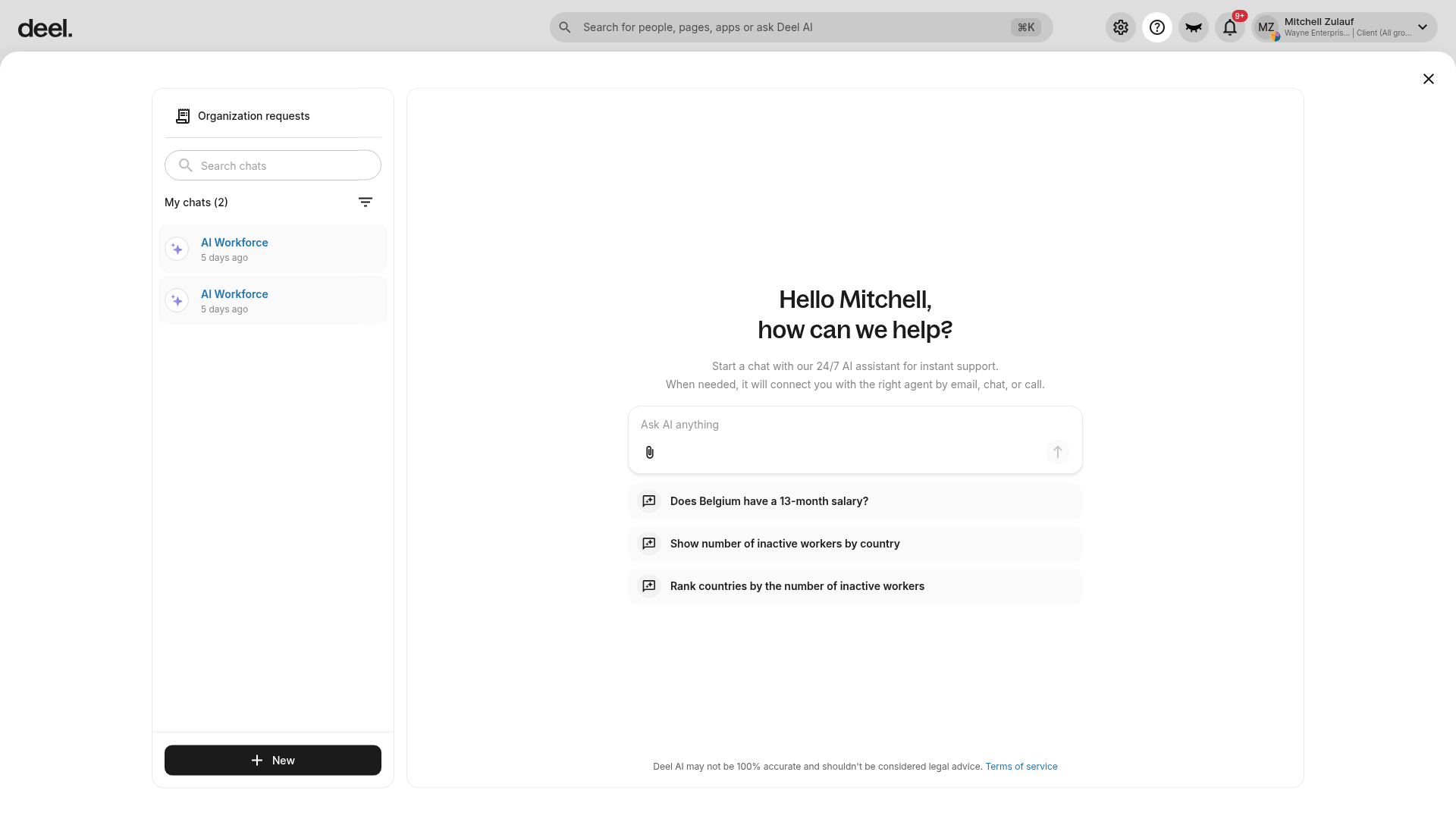
Wait for the Communication Center to load. Confirm that the support chat interface is open by checking for the My chats panel, the New button, and the Ask AI anything message field.
-
Select New and briefly describe the notice, including any deadline or urgency.
-
Attach the notice and any supporting documents, such as agency letters or payment confirmations.
-
Send the message. Our team will review the request and begin investigating.
Know more about how you can connect with support here How to Contact Deel for Support?
Common Payroll Tax Notices
-
Failure to File or Pay
These notices typically result from an incorrect deposit frequency or not having a valid tax identification number on file with the agency. -
Late Deposit Penalty
The IRS has strict due dates for tax payments. If a deposit is made late, a penalty notice will be issued. -
Deposit Frequency Change
This notice informs you of how often you must deposit payroll taxes (e.g. semiweekly, monthly). It’s important to forward this to Deel immediately so we can ensure compliance. -
Rate Notice (e.g., SUI)
States send these annually to inform employers of changes to their unemployment insurance rate, which is used to calculate state unemployment tax. -
Informational Notice
These notices are for your records only and do not require any action. They may include account confirmations, updates, or general communication from the agency.
If a notice is marked "informational" and doesn’t request action, you do not need to raise a Jira ticket.