
This article explains how to initiate termination or resignation for a PEO (Professional Employer Organization) employee, commonly known as "offboarding."
Before you begin:
For detailed information about the payout deadline for every state, see On-Demand Payroll Deadlines for Terminations.
Offboarding a PEO employee
✅ Step 1 – Schedule a termination request
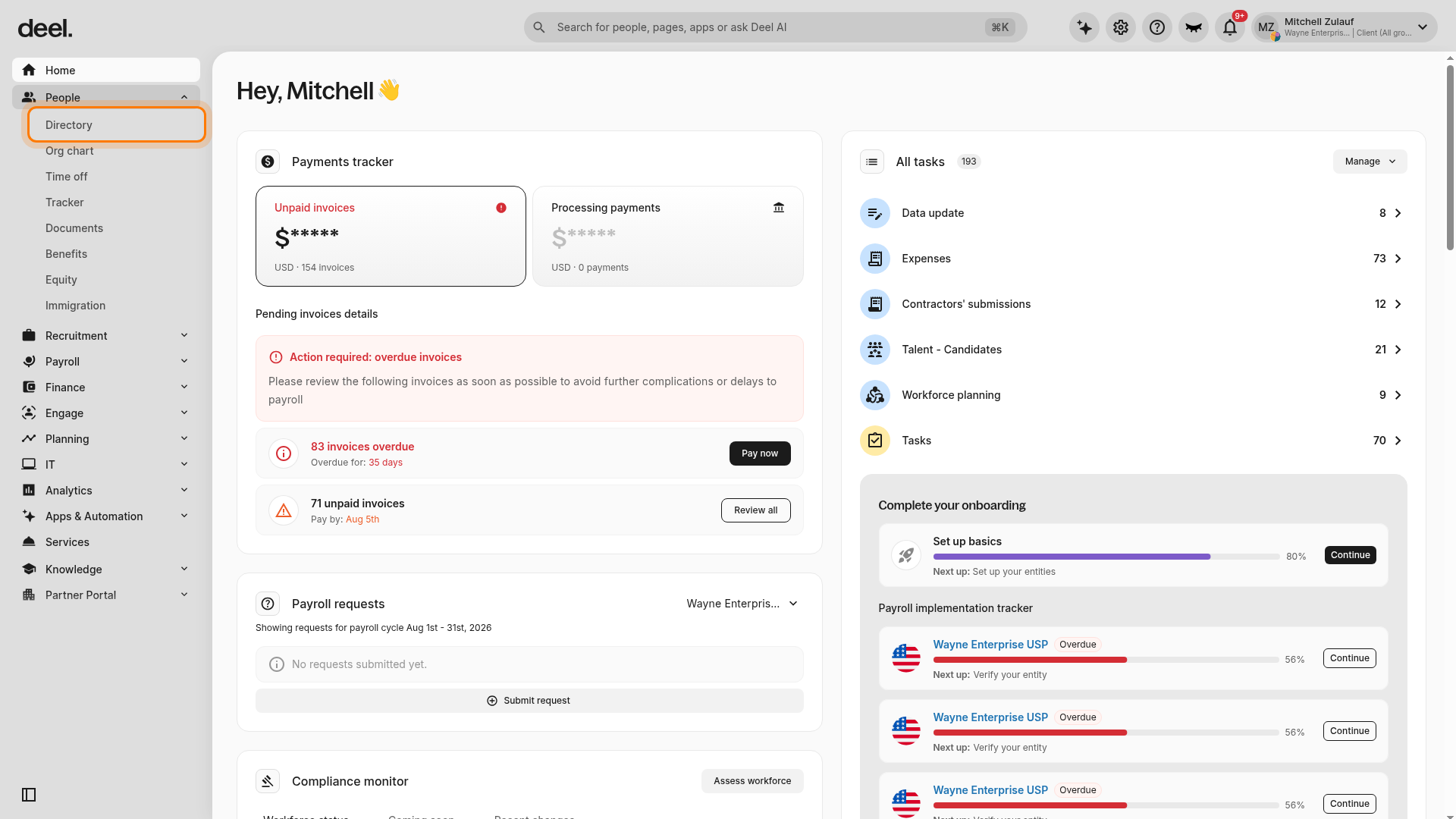
In the left sidebar, select People to expand the menu, then select Directory.
In Directory, locate the employee. Verify that the employee is in the United States, has a Worker type of Direct Employee Payroll, and has an Active worker status. Use the available Country, Worker type, and Worker status filters if needed.
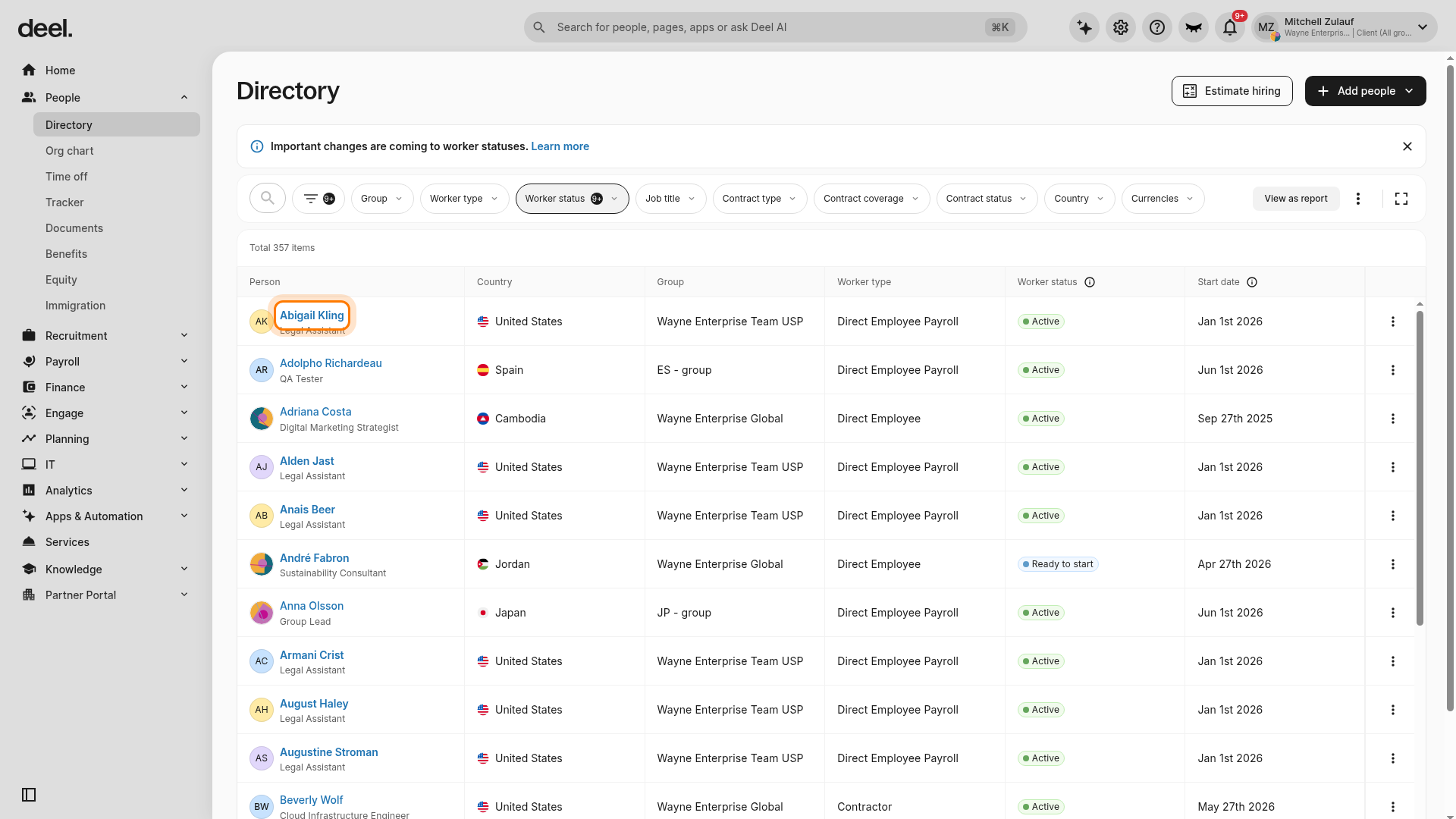
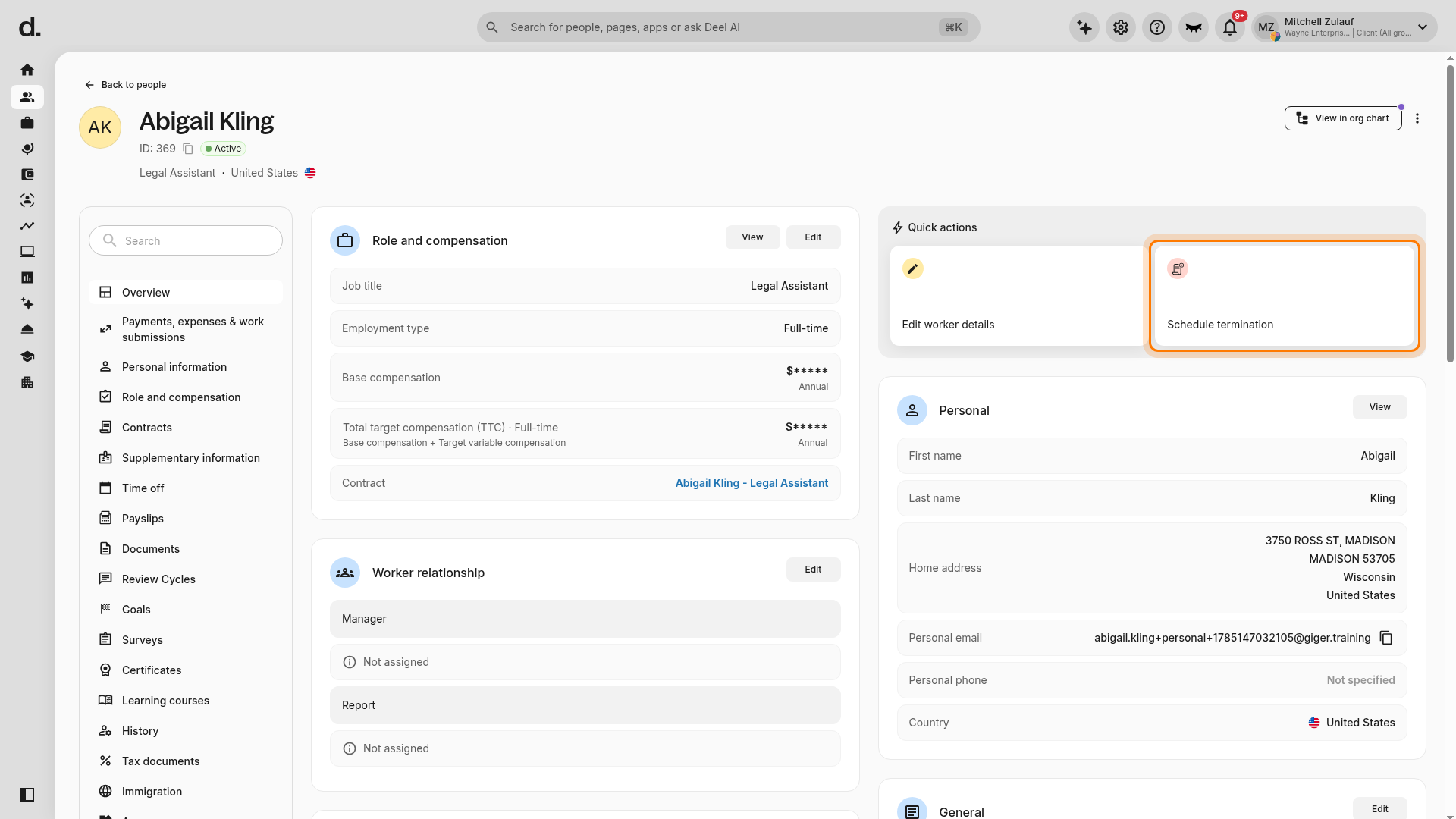
Select the employee's name and, on their profile, confirm the name, role, country, and Active status. On the employee's Overview page, select Schedule termination in the Quick actions panel.
In the End of contract dialog, select Terminate profile and contract for a complete employee offboarding, then select Continue.
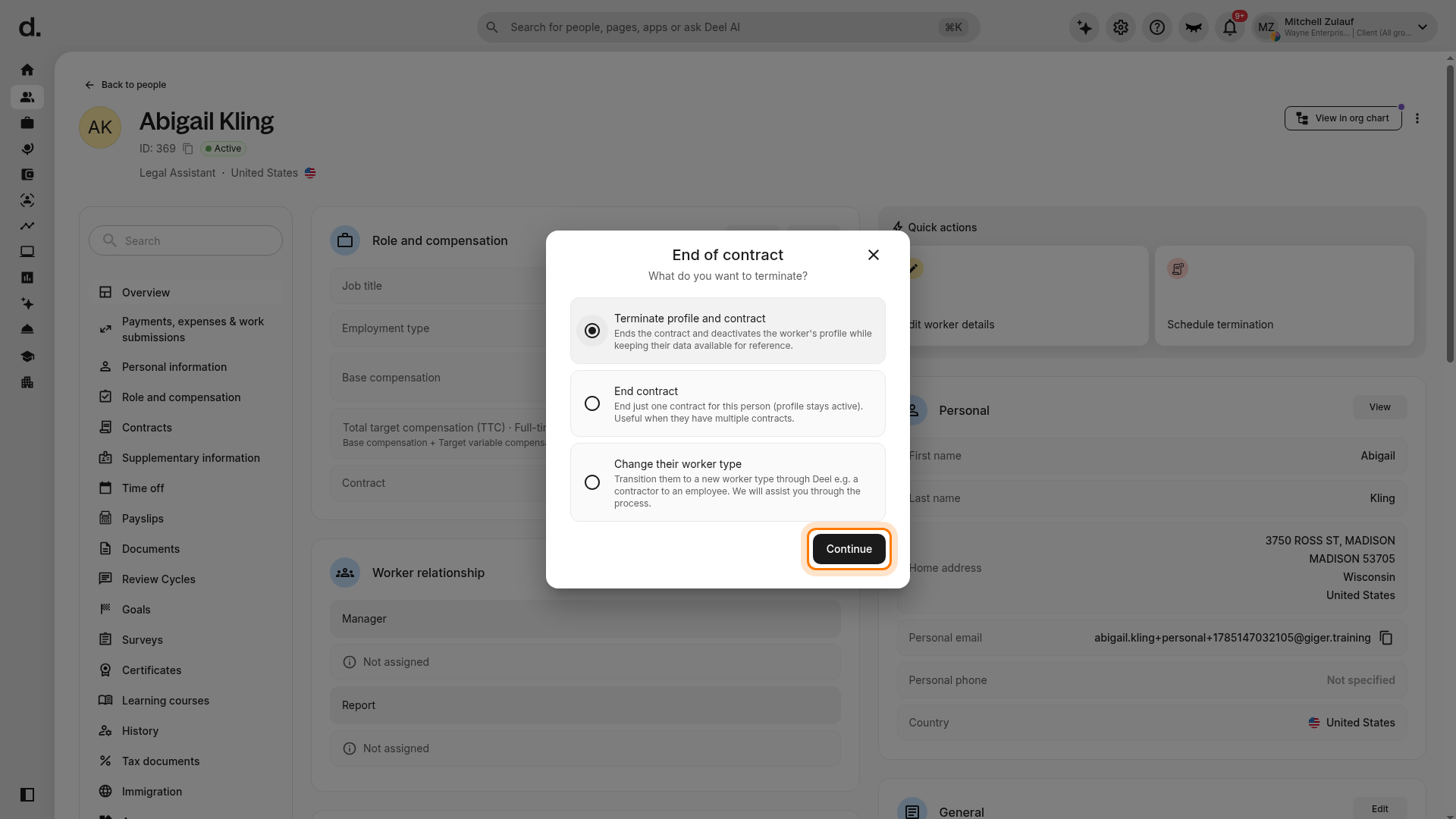
Important: Do not select End contract when the employee is leaving the organization entirely. That option ends one contract but keeps the worker profile active. Use it only when the worker has multiple contracts. Change their worker type starts a worker-type transition rather than an offboarding process.
The Worker Termination flow opens. Starting this flow does not notify the worker.
✅ Step 2 - Fill in the Termination Details
On the Worker Termination page, review the Worker details card to confirm that you selected the correct employee. Enter the employee's Last day of work in MM/DD/YYYY format and select the applicable Timezone.
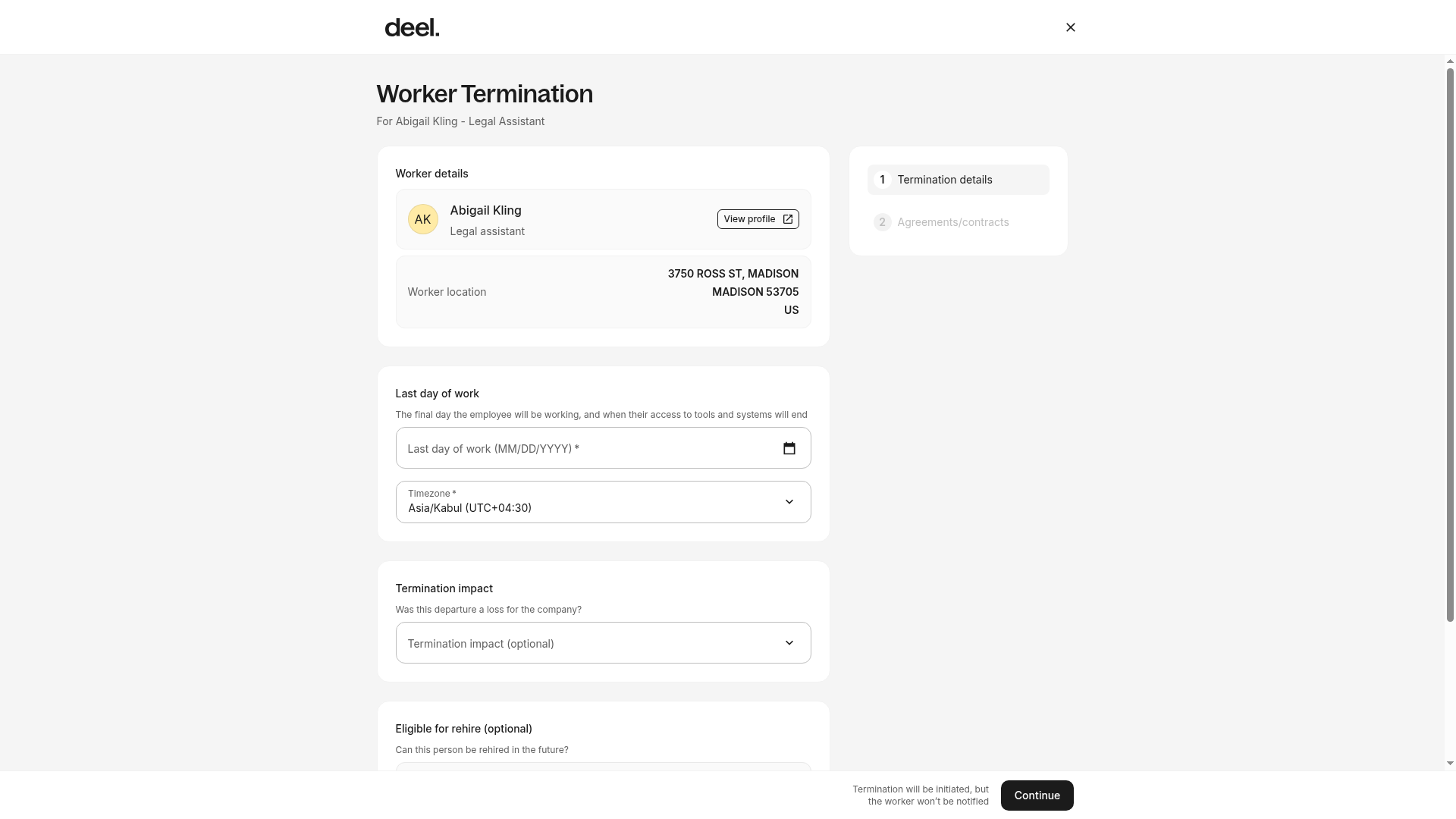
Complete Termination impact, if applicable, and Eligible for rehire (optional) if your organization has made that decision. Select the termination type (either resignation or termination) and provide a complete explanation of the reason for ending the employment. Review all entries, then click Continue to proceed.
Important Note on Termination Dates: The termination date should always reflect the employee’s last day worked. It should not include severance pay dates, pay in lieu of notice, garden leave, or COBRA coverage periods.
Using an incorrect date can delay or negatively impact unemployment insurance outcomes for employees. If you have any questions regarding which date to use, please contact your HR Experience Manager through the Deel platform.
✅ Step 3 - Add severance details
On the Severance details tab, select whether the employee will receive severance.
If no severance is required: Select "The employee will not receive severance" and continue. No further action is needed for severance.
If severance is required: Select the second option and enter the severance amount using one of two methods:
-
By time — Select a number of weeks (or other time unit). Deel will display a forecasted estimate of the payout amount.
- Note that this is an estimate only and the final amount may differ.
- By cash value — Enter a fixed dollar amount directly.
Next, indicate whether a severance agreement is required:
| Scenario | What happens |
|---|---|
| No agreement required | The off-cycle payment is created automatically once the termination is executed. |
| Agreement required, but not before payment | The termination proceeds. You will be notified to upload the signed agreement, but payment is not held. |
| Agreement required before payment | Payment is held. The off-cycle payment is created only after you upload the signed severance agreement. |
Once you complete this step, the termination summary screen will show a Severance details box confirming the amount entered, whether an agreement is pending upload, and how the payment will be processed.
✅ Step 4 - Submit termination request
After filling in all termination details, click Finish.
Deel will review the termination request and notify you of the next steps. Once the request is approved, the employee's contract details page will reflect that their contract is ending.
✅ Step 5 - Upload the signed severance agreement (if required)
If a severance agreement was indicated during the termination flow, you can upload the signed document from the Offboarding tracker after it has been signed by both parties.
To upload the agreement:
- Go to Offboarding tracker and find the employee.
- Select Contract ending details and click View to open the side panel.
- In the Severance details section, click Upload.
- Add or drag your file into the upload area, then click Upload to submit.
Important: Only upload the signed agreement after any applicable waiting period has passed.
Once the agreement is uploaded, the off-cycle payment is created automatically.
Need to adjust the severance amount? If the amount changed after the termination was initiated - for example, due to negotiations - you can update it directly in the off-cycle payment before approving it. Once the off-cycle is approved, changes must follow the standard off-cycle amendment process.
On-Demand Payroll Deadlines for Terminations
[ACCORDION] Expand to see the details…
The deadline to payout the final wage to an employee varies by state and it's determined by whether the employee resigned or was terminated by the company. This table lists such deadlines by state:
| State | Resigned employee deadline | Terminated employee deadline |
|---|---|---|
| Alabama | No law | No law |
| Alaska | Next scheduled payday that's at least 3 days after the employee gives notice | Within 3 working days of termination |
| Arizona | Next scheduled payday | Whichever is first: within 7 working days or next payday |
| Arkansas | No law | Next scheduled payday |
| California | Within 72 hours or immediately if the employee gave at least 72 hours' notice | Immediately (employees can recover penalties for everyday wages are withheld) |
| Colorado | Next scheduled payday | Immediately |
| Connecticut | Next scheduled payday | Next business day |
| Delaware | Next scheduled payday or 3 business days after last day of work, whichever is later | Next scheduled payday or 3 business days after last day of work, whichever is later |
| District of Columbia | Whichever is first: within 7 days or next payday | Next business day |
| Florida | No law | No law |
| Georgia | No law | No law |
| Hawaii | Immediately if employee gives one pay period notice, or scheduled payday | Immediately or next business day |
| Idaho | Whichever is first: within 10 days or next payday. If employee provides a written request for earlier payment, within 48 hours (excluding weekends and holidays) of receiving the request. | Whichever is first: within 10 days or next payday. If employee provides a written request for earlier payment, within 48 hours (excluding weekends and holidays) of receiving the request. |
| Illinois | Immediately if possible but no later than next scheduled payday | Immediately if possible but no later than next scheduled payday |
| Indiana | Next scheduled payday | Next scheduled payday |
| Iowa | Next scheduled payday | Next scheduled payday |
| Kansas | Next scheduled payday | Next scheduled payday |
| Kentucky | Whichever is later: within 14 days or next scheduled payday | Whichever is later: within 14 days or next scheduled payday |
| Louisiana | Whichever is first: next scheduled payday or within 15 days | Whichever is first: next scheduled payday or within 15 days |
| Maine | Next scheduled payday | Next scheduled payday |
| Maryland | Next scheduled payday | Next scheduled payday |
| Massachusetts | Next scheduled payday | Immediately |
| Michigan | Next scheduled payday | Next scheduled payday |
| Minnesota | Next payday that's at least 5 days after an employee's last day but no more than 20 days after the last day worked. | Immediately or if employee submits a written request, within 24 hours of demand |
| Mississippi | No law | No law |
| Missouri | No law | Immediately |
| Montana | Whichever is first: next scheduled payday or within 15 days | Immediately (within 4 hours or the end of the same business day) |
| Nebraska | Whichever is first: next scheduled payday or within two weeks | Whichever is first: next scheduled payday or within two weeks |
| Nevada | Whichever is first: within 7 days or next payday | Immediately |
| New Hampshire | Next scheduled payday, or within 72 hours if the employee gives one period pay notice | Within 72 hours |
| New Jersey | Next scheduled payday | Next scheduled payday |
| New Mexico | Next scheduled payday | Next scheduled payday (task, piece and commission wages due within 10 days). If wages are a fixed amount, they are due within 5 days of termination. |
| New York | Next scheduled payday | Next scheduled payday |
| North Carolina | Next scheduled payday | Next scheduled payday |
| North Dakota | Next scheduled payday | Next scheduled payday |
| Ohio | No law | No law |
| Oklahoma | Next scheduled payday | Next scheduled payday |
| Oregon | Immediately if the employee gave 48 hours notice, otherwise within 5 days, or the next payday, whichever comes first | By the end of the next business day |
| Pennsylvania | Next scheduled payday (If the employee requests the final check to be mailed, then the company is required to do so). | Next scheduled payday (If the employee requests the final check to be mailed, then the company is required to do so). |
| Rhode Island | Next scheduled payday | Next scheduled payday |
| South Carolina | Within 48 hours or next scheduled payday not to exceed 30 days | Within 48 hours or next scheduled payday not to exceed 30 days |
| South Dakota | Next scheduled payday, or the employer can hold the final pay until company property is returned. | Next scheduled payday, or the employer can hold the final pay until company property is returned. |
| Tennessee | Within 21 days or the next regular payday, whichever occurs later | Within 21 days or the next regular payday, whichever occurs later |
| Texas | Next scheduled payday | Within 6 calendar days |
| Utah | Next scheduled payday | Within 24 hours |
| Vermont | Whichever is first: next scheduled payday or if there is no regular payday, then the next Friday | Within 72 hours from the time of discharge |
| Virginia | Next scheduled payday | Next scheduled payday |
| Washington | Next scheduled payday | Next scheduled payday |
| West Virginia | Next scheduled payday | Next scheduled payday |
| Wisconsin | Whichever is earlier: Next scheduled payday, or in 31 days | Whichever is earlier: Next scheduled payday, or in 31 days |
| Wyoming | Next scheduled payday | Next scheduled payday |